
 Biogas Flares
Logical Waste Biogas Flare
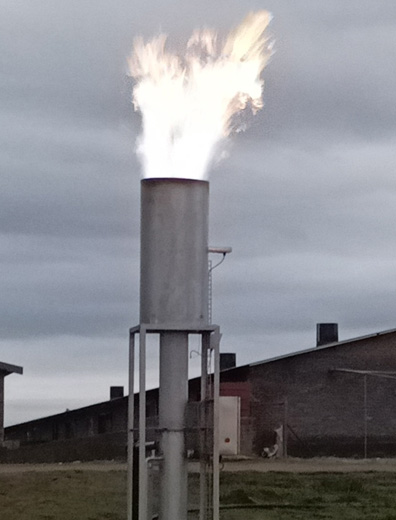
The LogicalWaste Hydraulic Flare (LWF-HS) is designed and manufactured with our patented hydraulic seal design along with automated safety controls to provide safe and reliable means of destroying excess biogas. The LWF-HS is designed to meet the demanding conditions of biogas plants with a focus on safety, reliability, and ease of operation.
Most flares incorporate shutoff solenoid valves and flame arrestors which rely on moving parts, frequent maintenance, and imported components. These systems can be prone to downtime, safety concerns, and costly servicing.
The patented LWF-HS uses a water chamber to create a hydraulic seal, preventing the flow of gas through the flare. To initiate gas flow, water is pumped to a secondary chamber allowing the flow of gas through the flare to the burners where gas destruction occurs.
Key Features
- Patented Fail-Safe Water Seal
The innovative design of the LWF-HS ensures inherent safety, as water will automatically return to the first chamber by gravity in the event of a power failure. Using this design completely eliminates the risk of uncontrolled gas escape. - Continuous Self-Verification
Most competitor flares rely on UV sensors that can fail unnoticed. The BioS2 flare is programmed to automatically test the UV sensor every 24 hours without operator intervention. If the sensor fails, the flare shuts down safely. - Fully Local Design & Support
Many flares are imported, which can create long delays for parts and service. The LogicalWaste flare is designed, manufactured, and supported locally, ensuring rapid spare parts supply, short lead times, and technical expertise on call. - Simple, Robust Components
The LWF-HS design avoids delicate mechanical components where possible. With a low-maintenance hydraulic system, H2S corrosion-resistant parts, and simple PLC control, the flare requires minimal operator attention compared to competitors. - Custom Sizing for Plant Efficiency
Unlike generic imported flares with fixed capacities, the LWF-HS series is sized for each plant’s maximum gas flow, optimizing combustion and efficiency.

 +27 82 6150 747